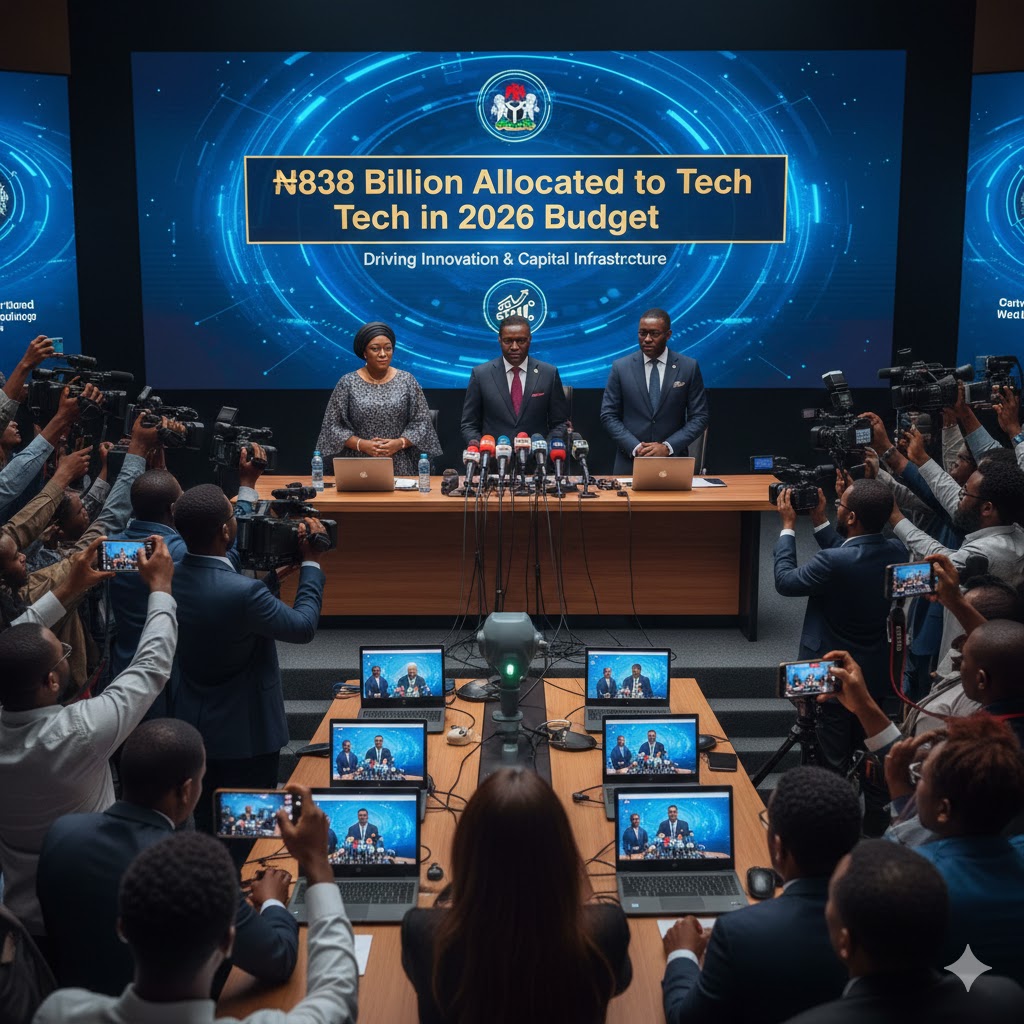
President Bola Ahmed Tinubu’s 2026 Appropriation Bill marks a historic turning point for Nigeria’s technological ambitions. By allocating ₦838.67 billion to Science, Technology, and Innovation, the administration is making its boldest bet yet on a knowledge-driven economy.
This allocation, titled under the “Budget of Consolidation, Renewed Resilience, and Shared Prosperity,” signals a move away from mere administrative spending toward deep-tech infrastructure and local commercialization.
The Great Capital Shift
The most striking feature of the 2026 budget is the concentration of funds into long-term assets. Of the total ₦838 billion, approximately ₦745.26 billion is dedicated to Capital Expenditure.
- Research Infrastructure: Building and equipping world-class laboratories and research centers across Nigeria’s six geopolitical zones.
- Commercialization: A new focus on moving “ideas from the lab to the market,” providing grants for startups and research institutes to prototype and mass-produce local inventions.
- Satellite & Biotechnology: Increased funding for agencies like NIGCOMSAT and NABDA to enhance national security and agricultural yield through tech.
Digital Economy: From Construction to Consolidation
While the Federal Ministry of Communications, Innovation, and Digital Economy saw its budget moderate to ₦84.56 billion (down from the infrastructure-heavy 2025 cycle), the focus has shifted to completing major ongoing projects.
- Project BRIDGE: Nigeria’s $2 billion fiber-optic rollout is moving into full-scale execution. The goal remains to expand the national backbone from 35,000km to 125,000km, targeting 70% broadband penetration by 2027.
- 3MTT Program: Sustained funding to continue training the 3 Million Technical Talents, ensuring Nigeria becomes a global exporter of tech skills.
- Cybersecurity: ₦279.76 million has been specifically carved out for high-end cybersecurity hardware and software to protect public digital infrastructure.
The $1 Trillion Ambition
Minister of Budget and Economic Planning, Senator Abubakar Atiku Bagudu, emphasized that these investments are the “engines” required to drive Nigeria toward a $1 trillion economy. By prioritizing tech, the government aims to reduce dependence on crude oil and foster a “bottom-up” economic growth model starting from all 8,809 political wards